
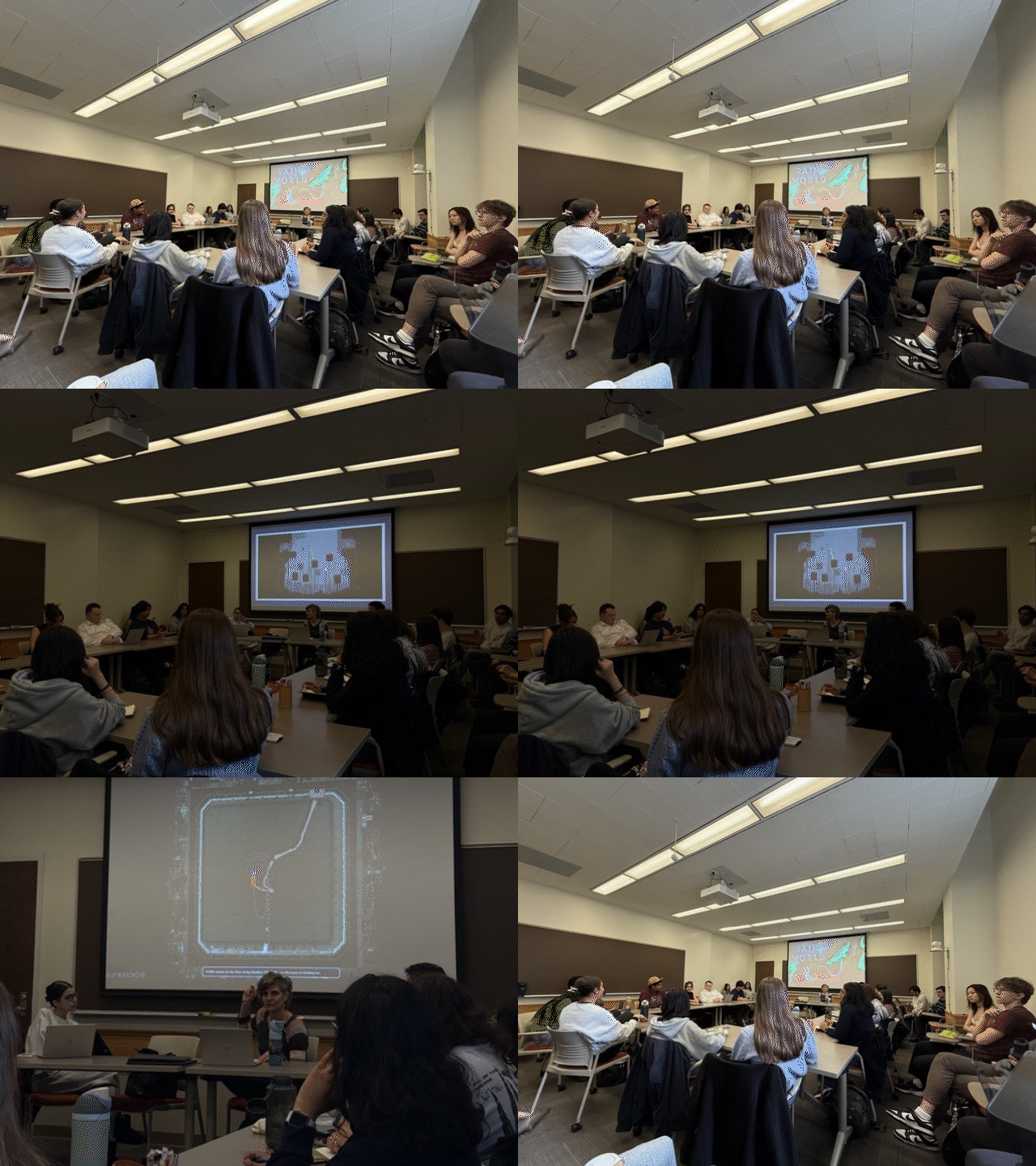
Few problems are as big and complex to tackle as climate change, but for the students at the University of Chicago’s “Serious Play: Video Games and Global Politics,” it’s a challenge they’re meeting head on. There are many ecosystems in the world on land and in the oceans where even the smallest change will disrupt the fragile balance that has remained there for thousands of years. Which led to the involvement of Videocult and Akupara Games, using the illustrative example of Rain World to help students sense the complex web of virtual ecology.
In Rain World, you play as a nomadic slugcat who survives in a crumbling environment left behind by an unknown advanced civilization. Find food, dodge predators, and find shelter before the inevitable bullet rain comes down. While the collapse of the society itself is applicable to the politics of Climate Change, there’s more than a simple slugcat’s journey.
Rain World was one of three games for the climate change section of the class, though, with two other strong indie titles being used to simulate the worldwide ecosystem as well.
- Eco is a simulation sandbox game where you build a civilization of real people, working together to advance society and stop a meteor, all without destroying the ecosystem in the process.
- The Climate Trail is about climate refugees fleeing ever-worsening conditions after inaction on climate has rendered much of the USA (and the world) uninhabitable. The game combines the adventure and play of the journey north with visual novel elements.
“Rain World felt very different from the other games because I never felt like the center of the world. Playing as a slugcat changed the whole experience. There was no real sense of ownership, progress, or morality in the usual game sense. I was not collecting resources to build an empire or improve my status. I was just trying to eat enough food to survive, avoid predators, and make it to hibernation before the rain came.”
During the class itself, students took a deep interest in Rain World, talking about how it decentralized humans in the issue of climate change and showed how all other creatures were also struggling with hunger and the environment along with the slugcat you are playing with. They aren’t attacking you because they are just a barrier to get passed, they are just trying to survive like you are. The interaction between the different creatures made the ecosystem feel alive despite it being in a dying world.
“The game gives you enough to move, climb, and survive, but not enough to feel secure. Between the hostile creatures, the need to find food, and the pressure of the rain cycle, exploration felt tense rather than empowering.”
I never thought that Rain World would ever be part of a classroom but I’m super honored that it was one of the games picked to learn about climate change and to be given the opportunity to teach others studying the field. Video games can be an amazing tool to teach and learn about the environment around you even if their goal isn’t to teach about the world. The simple act of driving a story yourself, making decisions about how to move through a game world, where to rest and where to press on, what to fight and what to run away from, these make games in general and stories in particular the perfect tool to bring out the next generation of climate scientists.
“The ruins never became beautiful to me the way I think they might on a second playthrough. I was too stressed. I was constantly miscalculating the distance back to hibernation spots, sometimes literally unable to reach food above me, and fighting to avoid predators. But I think that stress was the point. It wasn’t the stress of a ticking countdown or waning resource bar.”
I’m so glad that the students had a great time playing and studying Rain World with climate change. I hope their studies go well and that they learned a lot in the class.